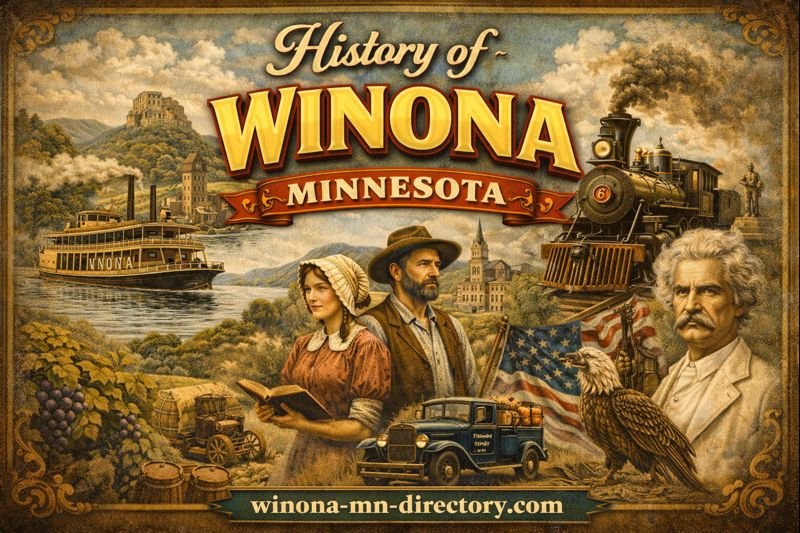
History of Winona, Minnesota
The Island City on the Mississippi River
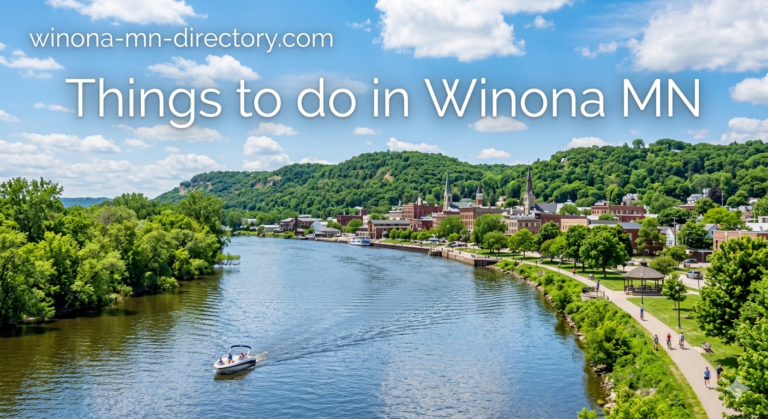
Nestled along the western bank of the Mississippi River in southeastern Minnesota, Winona stands as a testament to the rich tapestry of American history. From its origins as sacred Dakota land to its rise as a thriving river port and lumber capital, this “Island City” has witnessed centuries of transformation while maintaining its distinctive character among Minnesota’s most historic communities.
Ancient Origins & Dakota Heritage
Long before European settlers arrived, the Winona valley was home to generations of indigenous peoples. Archaeological evidence indicates human habitation in the area as early as 9500 B.C., with Woodland period sites dating from 800 B.C. to 900 A.D. The location that would become Winona was known as the village of Keoxa, home to the Mdewakanton band of the Dakota (Eastern Sioux) people.
The city derives its name from “Winuŋna” (pronounced wee-NEW-nuh), a Dakota word meaning “first-born daughter.” Led by a succession of Chiefs Wapasha, the Dakota prized this location for its expansive river vistas, abundant wildlife, and strategic access along the Mississippi. French explorers, including Franciscan missionary Louis Hennepin who visited around 1680, referred to the area as “La Prairie Aux-Ailes” or “Wing Prairie.”
Founding & Early Settlement (1851-1860)
The modern settlement of Winona began in 1851 when Captain Orrin Smith, a steamboat pilot who had sailed the Mississippi for over 25 years, recognized the area’s potential. Following the Treaties of Traverse des Sioux and Mendota, Smith landed his ship’s carpenter, Erwin Johnson, along with two other men to claim the riverfront property on October 15, 1851.
When surveyed in 1852 by John Ball, the town was initially named “Montezuma.” However, Henry D. Huff purchased an interest in the town site in 1853 and, with Smith’s consent, renamed it Winona to honor the legendary Dakota princess. The community grew rapidly, with the population surging from 815 in December 1855 to 3,000 by December 1856. German immigrants began arriving in 1856, joining the original New England settlers, and the first Polish immigrants followed in 1855.
Advertisement
The Inventor’s Velocity
Professional Web Development & Digital Marketing
WordPress Websites • Local SEO • Business Directories • Custom Solutions
Visit TIV360.com →The Golden Age: Wheat & Lumber (1860-1900)
During the 1860s, southern Minnesota emerged as America’s greatest wheat-producing region, and Winona became the primary shipping port for Minnesota wheat. By 1870, Winona ranked as the fourth largest wheat-shipping port in the entire United States. The railroad’s arrival in 1862 provided direct connection to Chicago, further accelerating the city’s growth.
The lumber industry propelled Winona to even greater heights. John Laird established the first lumber mill in 1855, later partnering with cousins James and Matthew Norton to form the Laird-Norton Company. At their peak in 1892, Winona’s sawmills produced over 160 million board feet annually, ranking eighth in lumber production across the upper Midwest. The city’s population reached 19,714 by 1900.
Industry & Innovation
Winona became home to several pioneering businesses that would achieve national prominence. In 1868, J.R. Watkins began selling liniment door-to-door, introducing the revolutionary “trial-mark bottle” and what many consider America’s first money-back guarantee. The company relocated to Winona in 1885 and by the 1940s had become the world’s largest direct-sales company. The Watkins headquarters, with its 70-foot gold-leafed dome and Tiffany stained glass windows, was listed on the National Register of Historic Places in 2004.
Bay State Milling was founded in 1899 and continues operations today. In 1947, brothers Harold “Hal” and Everett “Leonard” Edstrom, along with Roger Busdicker, founded the Hal Leonard Corporation. What began as arrangements for school bands grew into the world’s largest sheet music publisher, still maintaining distribution facilities in Winona.
A Center of Education
Winona established itself early as a center of higher learning. In 1858, Winona Normal School became the first teacher-training institution west of the Mississippi River, evolving into today’s Winona State University. Saint Mary’s College (now Saint Mary’s University of Minnesota) was founded in 1912 as a private Catholic, Lasallian institution. The city also hosted the College of Saint Teresa until its closure in 1988, with facilities now shared among the remaining institutions.
Historic Landmarks & Architecture
The dramatic bluff country of the Driftless Area provides Winona’s stunning natural backdrop. Sugar Loaf, an 85-foot limestone formation perched atop a 500-foot bluff above Lake Winona, has served as a river pilot’s landmark for generations. Garvin Heights Park offers panoramic views for miles along the Mississippi.
The wealth generated during Winona’s boom years left a lasting architectural legacy. The city boasts 13 blocks listed on the National Register of Historic Districts, featuring stunning stained glass, stone facades, and the architectural grandeur of the late 1800s. The Winona Commercial Historic District and East Second Street Commercial District preserve this heritage for future generations.
Notable Residents
Winona has been home to many distinguished individuals. William Windom (1827–1891) served in both the U.S. House and Senate from Minnesota before becoming Secretary of the Treasury. Actress Winona Ryder was born in the city and named after it. Olympic gold medalist swimmer Tracy Caulkins, former Yahoo! CEO Carol Bartz, and Minnesota’s first Attorney General Charles H. Berry all have Winona connections.
Winona Today
Modern Winona, with a population of 25,948 as of the 2020 census, remains the county seat of Winona County. The city’s economy has diversified to include electronics, composite materials, automotive parts, and tourism. The Minnesota Marine Art Museum and the rich cultural offerings of its two universities contribute to a vibrant community life. The Winona County Historical Society preserves the area’s heritage at the Winona County History Center, inviting visitors to discover what this remarkable place along the Mississippi means to them.
“The trail of names and spellings hints that this place along the Mississippi River means many different things to many different people.”
— Winona County Historical Society